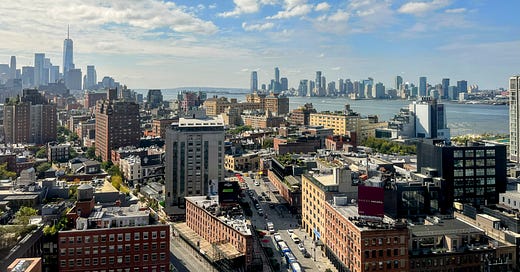
A new, solutions-first movement called the Abundance Agenda is gaining steam in NYC’s tech, policy, and planning circles. At its core: build more—homes, transit, and clean infrastructure—faster and smarter. NYC already flipped key levers in late 2024–2025 (City of Yes zoning reforms, new state tax incentives 485-x and 467-m, congestion pricing revenues, bus-tech enforcement, OMNY milestones, and IBX design). Expect targeted density near transit, office-to-residential conversions, faster buses, and a new Brooklyn-Queens rail link to reshape where New Yorkers live and how they move. None of this is a silver bullet—but together, it’s a real supply-side shift.
What is the “Abundance Agenda”?
The term “Abundance Agenda” first gained traction in tech policy circles nationally, especially in California’s housing debates, before finding an audience in New York. Its core philosophy—reducing regulatory barriers to building—has drawn both bipartisan political support and opposition, making it a rare policy frame that sparks discussion across ideological lines.
Why now? The urgency in one chart (and one number)
NYC’s rental vacancy rate is 1.4%—its lowest since 1968. In housing market terms, anything under 5% signals scarcity; healthy markets typically range between 5% and 8%. At 1.4%, competition for apartments is fierce, leading to bidding wars even for modest rentals and forcing many lower- and middle-income residents to move farther from job centers.
Permitting also slumped after the 421-a tax break expired. Just 15,626 homes were authorized in 2024, slightly below 2023 and far under the 2022 “beat-the-deadline” spike when developers rushed to secure permits before the tax program’s sunset. City Planning’s latest pipeline update and NYU Furman Center data underscore the supply gap—production is simply not keeping pace with population and job growth.
Housing: The concrete levers NYC has already pulled
1) City of Yes for Housing Opportunity (adopted Dec. 5, 2024)
NYC passed its most sweeping zoning update in decades to “build a little more housing in every neighborhood.” Highlights of the adopted package include:
-
Transit-oriented & town-center infill: allows 3–5 story apartment buildings near transit in low-density areas, with affordability requirements on larger projects.
-
More apartments above shops on commercial strips.
-
Accessory Dwelling Units (ADUs) in one- and two-family zones, with safeguards (for example, restrictions for flood-vulnerable areas added by the Council).
-
Parking reforms to align supply with reality near transit.
Use the City Planning guide and legal summaries to target opportunities.
Reality check: A lawsuit filed in 2025 challenges the environmental review approach. Policy remains in force unless courts say otherwise, but it’s a headline to watch.
2) State incentive 485-x (ANNY): the new 421-a replacement
New York State created RPTL 485-x in the FY25 budget. It offers long-term property tax exemptions for new rental or eligible ownership projects (6+ units) started June 15, 2022 – June 15, 2034 and completed by June 15, 2038—with affordability and labor standards. HPD reports early uptake in 2025.
3) Office-to-residential incentive 467-m
Another new tool: RPTL 467-m (AHCC) for converting obsolete commercial space to housing, typically requiring 25% income-restricted units and offering substantial property-tax relief (up to 35 years depending on location and start). The City Comptroller’s 2025 analysis explains the economics and fiscal impacts. The recently approved Midtown South rezoning is expected to work in tandem with 467-m incentives, unlocking more office-to-residential conversions in one of Manhattan’s most underutilized commercial districts. For example, a developer converting a vacant Midtown South office building under 467-m could receive up to 35 years of property tax relief, making a project financially viable that would otherwise be shelved due to high renovation costs.
Transit & Mobility: Why this matters for housing (and where it’s moving)
Congestion pricing is funding the backbone
Since January 5, 2025, NYC’s congestion pricing has operated below 60th Street, with revenue on track for $500 million in 2025, enabling up to $15 billion in MTA capital work. The Regional Plan Association details the pause and “un-pause” timeline that led to launch. Expect proceeds to accelerate station upgrades, signals, accessibility, and fleet investments that support denser living near transit.
Buses are getting tech-enforced priority
NYC’s Automated Camera Enforcement (ACE) now tickets bus-lane, bus-stop, and double-parking violations on camera-equipped routes. DOT’s 2024–2025 reports show expanding corridors, while the MTA’s ABLE→ACE transition is improving reliability. Paired with Transit Signal Priority rollouts, this is the quickest way to give riders time back.
Fare tech is standardizing access
OMNY is replacing MetroCard by the end of 2025 (with grace periods). As of March 2025, the MTA reported 55% reduced-fare riders and the vast majority of full-fare riders tapping. Expect more flexible products, better data, and tighter integration with commuter rail and buses.
Big rail projects you’ll hear more about
-
Second Avenue Subway, Phase 2: Federal $3.4B Full Funding Grant Agreement signed; early construction packages underway. Extending service to 125th Street is a once-in-a-generation capacity add for East Harlem.
-
Interborough Express (IBX): Now in design, funded by state and federal dollars; a 14-mile Brooklyn–Queens light rail linking 17 subway lines and 2 LIRR hubs. Completion is expected in the 2030s but land-use effects along the corridor will arrive earlier.
-
Penn Station Access (Bronx): Four new Metro-North stations are still coming, though delayed to ~2028. When finished, they’ll shorten East Bronx commutes and make those station areas prime for walkable housing growth. The MTA projects IBX could serve up to 88,000 daily riders, reducing travel times between certain Brooklyn and Queens neighborhoods from over an hour to under 30 minutes. SAS Phase 2 is expected to carry 123,000 daily riders and open new development potential in East Harlem.
What this could mean for supply, affordability, and neighborhoods
Near-term (12–24 months)
-
Small-scale infill near transit and on commercial corridors should pick up under City of Yes, especially where owners can assemble lots or add apartments above retail.
-
Conversions move from one-off prestige projects to a pipeline business model as 467-m pencils more buildings—particularly in Midtown South, FiDi, and select outer-borough business districts.
-
Bus corridors with ACE cameras and TSP become stickier locations for renters who value reliability; expect incremental rent premiums close to frequent bus priority corridors. (Inference based on enforcement + TSP research; watch DOT/MTA reports.)
Medium-term (2–5 years)
-
485-x production arrives (projects permitted/financed in 2025–2027 start delivering units).
-
Town-center zoning seeds mixed-use low-rise nodes near rail/subway, diversifying supply beyond the “mega-project or nothing” pattern.
-
Station-area uplift around future Penn Station Access stops in the Bronx (and, later, IBX) encourages walkable main-street investments. (Planning inference aligned with adopted policies and project timelines.)
Long-term (5–10+ years)
-
IBX rewires interborough travel, shrinking commutes that now detour through Manhattan and unlocking Brooklyn–Queens job-housing matches.
-
SAS Phase 2 expands high-capacity rail into East Harlem, a boon to both mobility and equitable access.
Risks and roadblocks to watch
-
Litigation over City of Yes could delay or alter implementation; track court outcomes.
-
Financing costs remain elevated; incentives help but don’t eliminate debt-service math.
-
Delivery capacity (design, approvals, utility coordination) can bottleneck even “as-of-right” projects.
-
Equity in fare tech: Reduced-fare OMNY adoption is improving but not universal; keep an eye on outreach and device access.
Who should lean in—and how
Developers & investors
-
Focus site selection within ½-mile of rail and on commercial strips in low-rise districts where City of Yes adds height/mixed-use potential.
-
Model 467-m and 485-x scenarios side-by-side; the optimal path may be conversion on one asset and new build on another.
Small property owners
-
Explore ADUs (where permitted) to add income and family flexibility; verify flood-zone limits and egress standards.
Neighborhood advocates
-
Tie public-realm asks (tree canopy, curb management, bus shelters) to bus-priority or station-area upgrades to capture quality-of-life co-benefits.
Renters and first-time buyers
Sources:
- A Little More Housing in Midtown South: City Kicks Off Rezoning to Create 10,000 New Homes
-
Vacancy emergency: HPD/NYCHVS 2023 initial findings; RGB 2024 Housing Supply Report
-
485-x (ANNY) & 467-m conversions: HPD program pages; NYS budget release; Comptroller analysis