
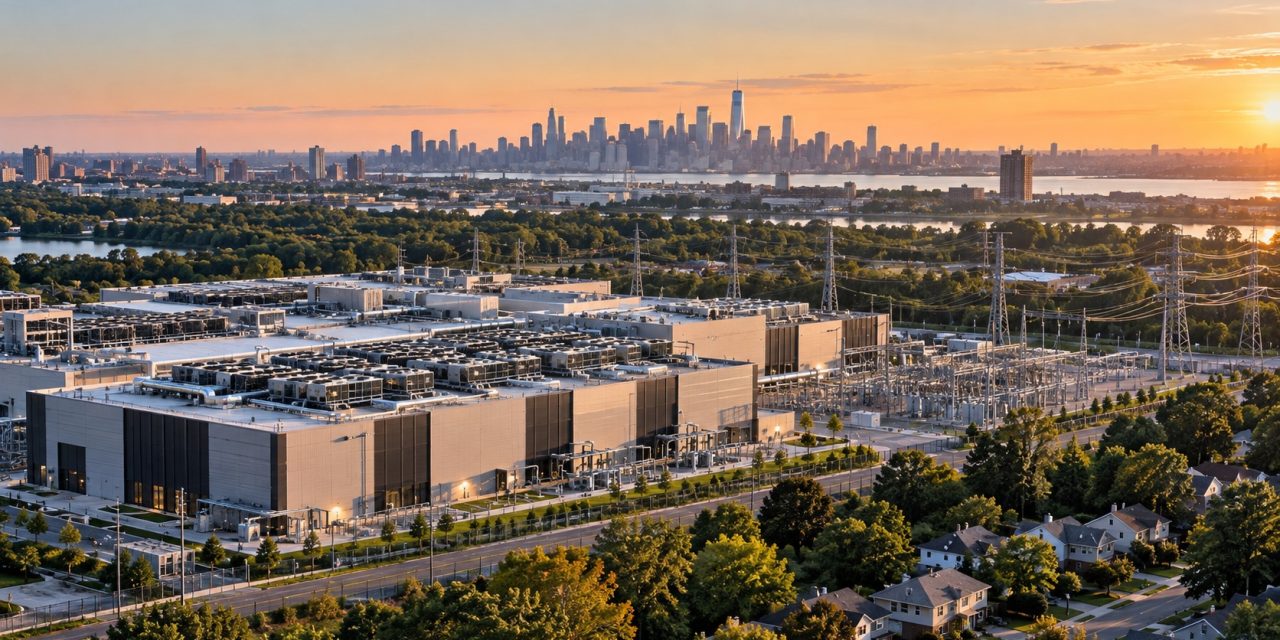
Billions of dollars are being invested in the infrastructure behind artificial intelligence, creating opportunities for economic growth while raising questions about energy costs, the environment, property values and the future of local communities.
Artificial intelligence is transforming the way we live, work and conduct business, and the enormous infrastructure required to support this technology is becoming one of the fastest growing sectors of commercial real estate. Across the United States, technology companies are acquiring land, constructing massive facilities and investing billions of dollars in the computing power necessary to support an increasingly digital economy.
The data center boom presents substantial opportunities for economic development, job creation, infrastructure improvements and local tax revenue. At the same time, the rapid expansion of these facilities has generated growing opposition among residents and elected officials concerned about electricity costs, water consumption, environmental impacts and the effect of large industrial developments on surrounding neighborhoods.
New York is confronting these competing interests at a critical moment. Governor Kathy Hochul has imposed a temporary moratorium on certain large data center projects while the state develops standards intended to protect consumers and communities. Meanwhile, other states continue attracting significant investment, raising questions about New York’s ability to remain competitive in an industry expected to play an increasingly important role in the national economy.
The debate extends beyond artificial intelligence or technology companies. It raises important questions about how land should be developed, who should pay for the infrastructure required by private businesses, what communities should receive in return and whether today’s investment decisions will provide lasting economic benefits.
As a real estate professional, I find the intersection of technology, property development and public policy particularly important. The decisions being made today could influence commercial property values, local economies, municipal finances and the character of communities for decades.
Understanding the Infrastructure Behind Artificial Intelligence
Data centers are specialized buildings that house computer servers, networking equipment and storage systems used to process, manage and transmit digital information. They support services that most of us rely upon every day, including banking, healthcare, communications, entertainment, online shopping and government operations.
Although these facilities have existed for decades, artificial intelligence has dramatically accelerated the demand for additional computing capacity. Training sophisticated AI models requires enormous processing power, while operating those systems for millions of users creates a continuing need for reliable computer infrastructure.
The result is an extraordinary construction cycle involving technology companies, commercial developers, institutional investors, utilities and equipment manufacturers.
Not every data center serves the same purpose or requires the same resources. Traditional facilities primarily support information storage and cloud computing, while newer operations designed for advanced AI applications can require substantially more electricity and sophisticated cooling equipment.
The largest developments, commonly known as hyperscale data centers, may contain multiple buildings spread across hundreds of acres. Smaller facilities can operate within existing industrial properties or commercial buildings, depending on their intended use and electrical requirements.
This distinction is important because treating every data center as though it has the same environmental impact, economic value or infrastructure requirements can lead to misleading conclusions.
The Data Center Boom Is Transforming the American Landscape
The scale of construction is remarkable, particularly when viewed from above. An October 5 report in The New York Times, using information from energy data company Cleanview, illustrated how large computing campuses are transforming previously undeveloped land, expanding established industrial sites and moving closer to residential neighborhoods.
According to Cleanview, approximately 180 new data center buildings were completed throughout the United States in 2025, representing an increase of 170% compared with 2021. Another 88 buildings had been completed during 2026 as of the Times report, with additional developments under construction or planned.
These projects are changing the physical landscape in states including Virginia, Texas, Georgia, Arizona, Pennsylvania and Ohio. Some have replaced former industrial properties, while others occupy substantial tracts of land that previously supported agriculture, open space or less intensive uses.
One particularly ambitious proposal, the Stratos Project in Utah, has attracted attention because of its extraordinary acreage and the debate surrounding its environmental and community impacts. Other major facilities under development demonstrate how the industry is moving toward campuses that require electrical capacity comparable to that of substantial population centers.
Investment commitments are equally significant. Amazon has announced approximately $20 billion for data center infrastructure in Pennsylvania and $15 billion in Indiana, along with multibillion dollar projects in other states. Microsoft, Google, Meta and additional technology businesses are also expanding their computing operations.
It is important to distinguish announced investments from money already spent. Some projects will take years to complete, and others may be modified, delayed or abandoned as market conditions and regulatory requirements change.
Nevertheless, the overall trend is clear. The infrastructure supporting artificial intelligence is becoming a major source of construction activity, capital investment and demand for suitable commercial real estate.
The Economic Benefits of Data Center Development
Construction Jobs and Opportunities for Skilled Workers
One of the strongest arguments in favor of these facilities is their ability to generate construction employment and demand for specialized services.
Developing a large data center requires electricians, engineers, HVAC technicians, plumbers, equipment installers, construction managers, architects and numerous other professionals. Projects may take several years to complete, providing employment opportunities and substantial contracts for construction companies and suppliers.
The surrounding economy can also benefit as workers patronize restaurants, retailers, hotels and other local businesses. In communities where traditional manufacturing activity has declined, a substantial technology infrastructure project may provide new opportunities for workers with relevant trade experience.
Once completed, facilities require employees to maintain computer equipment, manage electrical systems, monitor security and oversee daily operations. These positions can be well compensated and may encourage partnerships with vocational schools, community colleges and workforce development organizations.
However, the distinction between construction employment and permanent staffing is essential. Because data centers are highly automated, the number of employees needed to operate a completed facility is often considerably smaller than the workforce required to build it.
A municipality evaluating a proposed development should therefore examine the number of temporary and permanent jobs separately, including projected wages, training opportunities and the likelihood that local residents will fill those positions.
Tax Revenue and Municipal Financial Benefits
Data centers can generate substantial property tax revenue because of the value of their buildings, land and expensive equipment, although the amount collected depends on local tax laws and available incentives.
Loudoun County, Virginia, provides an important example. According to the county’s official financial information, data centers generated approximately $1.2 billion in real and personal property tax revenue during fiscal year 2026, representing roughly 39 percent of the county’s overall budget.
This revenue helps support public services and demonstrates why some municipalities view technology infrastructure as an opportunity to strengthen their financial position.
The potential benefits may include improved schools, transportation infrastructure, public safety services and other municipal priorities. For homeowners, a stronger commercial tax base can potentially reduce pressure on residential property taxes, provided the additional revenue is not offset by substantial public expenditures.
However, the financial outcome depends on the terms negotiated with developers. Tax exemptions, equipment depreciation, infrastructure expenses and other concessions can considerably reduce the net benefit.
A billion dollar investment does not necessarily translate into a comparable economic return for the host community. Municipalities should evaluate projected tax collections over time, together with the public costs and incentives associated with each project.
Technology, Business Growth and Economic Competitiveness
The economic benefits extend beyond construction and taxation because reliable digital infrastructure supports numerous industries, including financial services, healthcare, logistics, research and communications.
Businesses increasingly depend on cloud applications, advanced analytics and artificial intelligence to operate efficiently. Having access to dependable computing resources can support innovation and help attract companies that require substantial technological capacity.
For New York, this consideration is particularly relevant. The state is home to major financial institutions, research universities, healthcare systems and an expanding technology industry, all of which depend on sophisticated digital services.
The infrastructure supporting those industries does not necessarily need to be located within New York’s borders, but certain applications benefit from facilities closer to the customers and businesses they serve.
Maintaining access to modern computing resources will remain important to the state’s economic future, even as policymakers debate where new facilities should be constructed.
The Growing Concern Over Electricity Consumption
Among the most significant disadvantages associated with the data center boom is the extraordinary demand it places on electricity generation and distribution systems.
Unlike many commercial buildings, which experience fluctuations in energy use throughout the day, large computing facilities often operate continuously. Maintaining reliable service requires substantial electrical capacity, backup systems and infrastructure capable of accommodating sustained demand.
A June 2026 report from Lawrence Berkeley National Laboratory estimates that data centers could account for approximately 11.8% of total United States electricity consumption by 2030. The report projects a possible range of 9.5 percent to 15.3 percent, depending on future computing demand, technological efficiency and other factors.
These projections help explain why utility companies are increasingly concerned about their ability to accommodate the industry’s growth.
Electrical infrastructure in many parts of the country is decades old, and expanding capacity requires substantial investment. New transmission lines, substations, transformers and generation facilities can take years to plan, approve and construct.
The central question is who should pay for those improvements.
When a private development creates the need for additional infrastructure, utility regulators must determine which costs should be assigned to the business and which, if any, should be distributed among existing customers.
If expenses are spread across the broader customer base, households and small businesses could end up financing improvements largely required by a much larger electricity consumer.
Conversely, appropriately structured agreements can require developers to cover their direct costs and contribute toward broader grid improvements.
This distinction is particularly important in New York, where electricity affordability is already a significant concern for residents and businesses. Economic development should not automatically result in higher utility bills for communities that may receive relatively limited direct benefits.
Water Consumption, Cooling Systems and Environmental Impacts
Electricity is only one component of the environmental debate. Data centers generate substantial heat, and maintaining appropriate operating temperatures requires sophisticated cooling systems.
Some facilities use evaporative cooling, which can consume significant amounts of water, particularly in warmer climates or during periods of intense computing activity. Others rely on air cooling, liquid cooling or combinations of technologies designed to manage heat more efficiently.
Modern liquid cooling systems can circulate coolant directly to computer equipment, helping accommodate the increasingly powerful processors used in advanced AI applications.
Certain closed loop systems reuse water or other cooling fluids, reducing the need for continuous replacement. However, the overall environmental impact still depends on system design, electricity consumption, local climate and how heat is ultimately removed from the facility.
Consequently, not every data center consumes the same amount of water, and it would be inaccurate to assume that all operations place identical demands on municipal supplies.
The location of a project also matters. A facility in a region with abundant water resources may present different challenges from one proposed in an area already experiencing drought or infrastructure shortages.
Environmental considerations extend beyond cooling. Backup generators, on site power plants, construction equipment and increased demand for electricity can contribute to air pollution and greenhouse gas emissions, depending on the energy sources involved.
Large facilities may also generate continuous mechanical noise from cooling equipment and other operations. These impacts can become particularly contentious when industrial sites are situated near homes, schools, recreational areas or environmentally sensitive land.
Developers should therefore provide reliable information about projected water use, noise levels, emissions and electricity requirements before communities are asked to approve substantial projects.
Generating Their Own Electricity May Help, but It Introduces Other Challenges
As access to the electrical grid becomes increasingly constrained, some developers are exploring facilities capable of generating part or all of their own electricity.
These arrangements can involve natural gas turbines, solar installations, battery storage or combinations of generation technologies. In certain circumstances, independent power production may help a project move forward without waiting years for major utility upgrades.
However, producing electricity on site does not necessarily eliminate environmental concerns. Natural gas facilities still generate emissions, while power generation equipment requires land, maintenance, permitting and substantial investment.
A development that reduces pressure on the existing grid could still introduce air quality or noise concerns that need to be evaluated independently.
The financial and regulatory requirements can also be complicated. Developers must determine whether they can legally generate power for their own use, provide electricity to tenants or sell excess energy, depending on applicable utility regulations.
These considerations illustrate why data centers are no longer simply buildings filled with computers. Increasingly, they are complex real estate and energy infrastructure investments that require expertise across multiple industries.
The Potential Impact on Residential Neighborhoods and Property Values
For homeowners, the most immediate concerns may have little to do with artificial intelligence and much more to do with everyday quality of life.
Residents living near proposed facilities may worry about construction traffic, noise, lighting, changes to the landscape and the amount of land devoted to industrial operations.
Depending on the location, additional electrical substations, transmission equipment or generating facilities may also affect the appearance and character of surrounding neighborhoods.
These issues can influence how buyers perceive a community, particularly when residential properties are located close to substantial industrial development.
However, it would be misleading to conclude that data centers automatically cause residential property values to decline. Property values depend on numerous factors, including location, housing supply, local taxes, employment opportunities, neighborhood amenities and the actual impacts of nearby development.
A municipality benefiting from significant commercial tax revenue may be able to improve public services or stabilize property taxes, potentially supporting residential demand. In another location, excessive noise, visual impacts or industrial encroachment could make nearby homes less attractive to certain buyers.
The effect must be evaluated on a case by case basis, using market evidence rather than assumptions.
As real estate professionals, we understand that buyers consider much more than a property’s interior condition or square footage. The surrounding environment, accessibility, public services, infrastructure and anticipated neighborhood changes all contribute to purchasing decisions.
Residents therefore have a legitimate interest in understanding how a proposed facility could affect their community, particularly when development involves substantial changes to established land uses.
Why Governor Hochul Paused Certain Data Center Projects in New York
On July 14, 2026, Governor Kathy Hochul signed Executive Order 62, establishing a temporary statewide permitting moratorium affecting new hyperscale data centers capable of consuming 50 megawatts or more of electricity.
The order pauses certain state environmental permitting decisions for up to one year while officials develop standards addressing electricity demand, water consumption, air quality and other potential impacts.
Importantly, the moratorium is not a blanket prohibition on all data center development. It applies to qualifying facilities and specified state permitting processes, with distinctions for applications already deemed complete when the order took effect.
Smaller projects may continue to move through applicable approval procedures, although municipal zoning regulations and local restrictions can impose additional requirements.
Hochul’s administration has also directed the Department of Public Service to examine measures requiring large energy consumers to pay more of the costs associated with their electricity demands or provide their own generation capacity.
Other proposals involve creating a framework for community investment agreements and reconsidering certain sales tax exemptions available to large data center developments.
The administration argues that these measures will help ensure that technological progress does not impose unreasonable financial or environmental burdens on residents.
There is a legitimate case for taking time to establish comprehensive standards, particularly when projects are being proposed faster than existing infrastructure can accommodate them.
Nevertheless, critics argue that uncertainty and delays can discourage investment, especially when companies have alternative locations available in other states.
For New York, the challenge is developing effective protections without creating an approval process so unpredictable that businesses simply choose to invest elsewhere.
A Separate Proposal Would Cover Smaller Facilities
The debate is not limited to the governor’s executive order.
State Senator Kristen Gonzalez has sponsored the Responsible Data Center Development Act, which passed the Legislature in June 2026 but has not been signed into law as of October 10.
The legislation would impose a one year moratorium on certain permits for large facilities beginning at a lower threshold of 20 megawatts, while establishing additional requirements concerning electricity and water rates, environmental review, labor protections and community benefits.
This distinction matters because a facility below the governor’s 50 megawatt threshold can still require significant infrastructure and potentially affect nearby neighborhoods.
The legislation reflects an effort to develop broader standards, although its ultimate requirements will depend on whether the governor signs the measure and how those provisions are implemented.
Community Opposition Is Growing Across New York
The statewide discussion is already influencing local decisions, particularly in communities where proposed developments are located near residential neighborhoods.
In Orangetown, Rockland County, residents have expressed concerns about an expansion involving DataBank’s Orangeburg facility. The proposed project could reach approximately 45 megawatts of electrical demand, placing it below the threshold established by Hochul’s executive order.
Opponents have raised questions about the facility’s proximity to residential areas, recreational facilities and Lake Tappan, along with its potential environmental impacts.
DataBank has disputed concerns about water consumption, explaining that its operations do not withdraw water from or discharge water into the reservoir. The company has also emphasized that data centers support essential services beyond artificial intelligence, including banking, healthcare and government operations.
Orangetown adopted its own temporary moratorium, although applications submitted before July 1 were permitted to continue through the approval process.
The dispute demonstrates why individual projects need to be evaluated on their actual characteristics rather than broad assumptions about the industry.
Similar debates are occurring in Western New York. West Seneca recently approved a one year moratorium, while Tonawanda has adopted restrictions and Buffalo officials have been considering additional regulations.
Local governments are examining whether existing zoning rules adequately address power consumption, environmental impacts, building location and compatibility with neighboring uses.
The Debate Reaches Dutchess County
The controversy has also intensified in Dutchess County, where proposed data center development has prompted questions about agricultural land, infrastructure requirements and regional economic priorities.
On October 9, Governor Hochul joined State Senator Kristen Gonzalez, Representatives Alexandria Ocasio-Cortez and Pat Ryan, State Senator Michelle Hinchey and local stakeholders for a roundtable at Fishkill Farms.
The discussion focused on concerns about the industry’s demand for electricity, water and land, particularly regarding the potential effects on agriculture, local businesses and communities.
The meeting illustrates how quickly this issue has moved from specialized commercial real estate discussions into mainstream public policy.
It also demonstrates that the debate crosses political and geographic boundaries. Whether a community is urban, suburban or rural, residents increasingly want to understand what a proposed facility will require and what they can expect to receive in return.
What I Learned at the Commercial Observer Data Center Forum
On October 6, I attended the Commercial Observer Data Centers Development and Infrastructure Forum at the City University of New York Graduate Center in Manhattan. The event brought together attorneys, developers, investors, lenders, engineers and other industry professionals to examine how artificial intelligence is transforming commercial real estate, infrastructure investment and economic development.
One of the most important takeaways was that developing a data center involves considerably more than acquiring land and constructing buildings. These projects require extensive coordination among property owners, utility companies, financial institutions, government agencies and technology businesses. Access to electricity, environmental approvals, infrastructure costs and community acceptance can ultimately determine whether a proposed development moves forward.
Jeffrey Moerdler, chair of the Data Centers and Digital Infrastructure Practice Group at Haynes Boone, opened the forum with an overview of the industry’s evolution and the challenges associated with its rapid expansion. His presentation examined several important developments, including specialized cloud computing providers, cooling technologies, independent power generation and the growing need for flexibility in complex real estate agreements. He also discussed the increasing importance of smaller facilities located closer to major population centers, where certain artificial intelligence applications require faster access to computing resources.
Throughout the forum, panelists explored the opportunities and risks facing developers and investors, particularly the importance of securing sufficient electrical capacity, obtaining necessary permits and structuring financing arrangements that account for long term operating costs. Discussions also addressed the growing opposition from communities concerned about electricity prices, water consumption, environmental impacts and the suitability of large facilities near established residential neighborhoods.
What I found particularly relevant from a real estate perspective was the increasing importance of infrastructure availability and regulatory certainty in determining a property’s development potential. A parcel may offer substantial acreage and an attractive location, but without sufficient electricity, appropriate zoning, necessary approvals and a financially viable development plan, its suitability for a data center can be considerably limited. The discussions reinforced how closely the future of this growing industry is tied to real estate, energy policy, financing and the interests of the communities where these facilities are being proposed.
Electricity Availability Is Becoming as Important as Location
Traditional commercial real estate analysis emphasizes location, property condition, operating income, tenant demand and comparable transactions. Although these considerations remain relevant, the growth of data centers has introduced another factor that can determine whether a property is suitable for development. Even a large parcel with favorable zoning may have limited potential if sufficient electricity is unavailable or cannot be delivered within a reasonable time frame.
At the forum, MD Sakib of National Grid explained that the queue for large electrical loads he oversees had increased from approximately one gigawatt to 13 gigawatts over four years. Although these figures represent requests for electrical capacity rather than electricity already being consumed, they illustrate the extraordinary demand being placed on utility infrastructure and the challenges associated with accommodating new development.
For investors and developers, the availability of power has become an essential consideration before acquiring land or committing substantial capital. Beyond determining whether sufficient capacity exists, they must evaluate the cost and timing of utility connections, transmission upgrades, necessary permits and future expansion. Properties where these requirements have already been addressed may offer significant advantages over otherwise comparable sites facing years of uncertainty.
Urban and Suburban Data Centers Present Different Opportunities
Another important discussion concerned the distinction between the enormous campuses used to train artificial intelligence models and smaller facilities that support applications closer to major population centers. Jeffrey Moerdler addressed the growing importance of AI inference, the process through which trained systems respond to questions, analyze information and perform tasks for businesses and consumers.
While training advanced models requires substantial computing resources that can be located in more remote areas, certain applications benefit from having processing capacity closer to the people and organizations using them. Shorter distances can reduce delays in transmitting information, making strategically located facilities particularly attractive for services requiring rapid responses.
This distinction creates opportunities for appropriately situated properties in urban and suburban markets, including the New York metropolitan area, where financial institutions, healthcare providers, technology companies and other businesses depend on fast and reliable digital connections. However, higher land costs, limited electrical capacity and local zoning requirements can complicate development. Smaller facilities may therefore represent a more practical alternative to massive computing campuses in certain locations, provided their infrastructure needs and operating expenses can be accommodated.
Financing and Technology Introduce Additional Risks
The forum also examined the increasingly complicated financing arrangements associated with data center development. These facilities can require enormous capital investments, specialized equipment and substantial financial commitments to utilities before they begin generating revenue. As a result, lenders and investors must look beyond the underlying property’s value and carefully evaluate the financial strength of tenants, the terms of their leases and the long term viability of the operation.
One emerging area of concern involves specialized cloud computing companies, commonly known as neoclouds, which provide customers with access to powerful processors used for artificial intelligence. These businesses can create additional demand for computing facilities, but some have limited operating histories, depend heavily on outside financing or enter into customer agreements that may be shorter than the useful life of the expensive equipment they operate.
Moerdler questioned the long term prospects of certain neocloud business models, particularly given the speed at which technology is changing. Computer equipment can become outdated, operating expenses may increase and customers may require different configurations as artificial intelligence continues to evolve.
These uncertainties make tenant creditworthiness, lease duration, renewal provisions, equipment replacement obligations and the ability to accommodate future technological changes particularly important. A sophisticated facility leased to a financially established company may present a very different investment profile from a speculative development dependent on a newer operator with limited financial resources.
For developers, lenders and property owners, the growing demand for digital infrastructure offers considerable opportunity, but successful investments will depend on careful financial analysis, dependable tenants and the ability to adapt to an industry that continues to evolve rapidly.
The Economic Cost of Saying Not Yet
New York’s temporary moratorium raises another question that deserves careful consideration. What happens to potential investment while the state develops its regulatory framework?
Businesses making major infrastructure decisions must evaluate construction timelines, electricity availability, permitting requirements, operating expenses and access to capital.
When a project encounters prolonged uncertainty, companies may consider alternative locations where the necessary approvals and resources can be secured more predictably.
Once a substantial campus has been constructed, the surrounding infrastructure, suppliers and workforce relationships may encourage additional investment in the same region.
This creates the possibility that some opportunities could move elsewhere if New York cannot provide a workable development process.
However, it is equally important not to exaggerate that risk. The billions being invested in Pennsylvania, Indiana, Georgia and other states would not necessarily have been directed to New York without the moratorium.
Different markets offer different advantages, and developers may have selected those locations regardless of New York’s policies.
The economic question is therefore not whether every announced project represents lost revenue for New York. It is whether the state can attract an appropriate share of future development while maintaining the protections its residents expect.
That requires a clear understanding of what the industry needs, what communities are willing to accommodate and whether the anticipated benefits justify the costs.
Amazon Is Responding to Public Opposition
The industry’s growing concern about community resistance is reflected in a recent announcement from Amazon Web Services.
On October 2, Amazon announced its Built Together initiative, committing more than $1 billion over five years to communities hosting its data centers in the United States.
The company intends to direct funding toward education, workforce training, energy affordability, water conservation and other community priorities.
Amazon has also announced changes intended to improve transparency, including a commitment to stop requiring nondisclosure agreements with government agencies concerning its data center developments.
These initiatives represent an acknowledgment that companies can no longer rely exclusively on promises of investment and job creation to obtain community support.
Residents want meaningful information about how a proposed project will affect their neighborhood, what public resources will be required and whether financial commitments will produce measurable benefits.
The company has indicated that local organizations and community priorities will help determine how the funding is used.
Nevertheless, the effectiveness of these programs should be evaluated over time. A substantial national commitment may provide valuable support, but the amount reaching an individual community can vary significantly.
Corporate contributions also should not replace independent environmental review, appropriate utility agreements or legally enforceable protections.
Community investment programs are most meaningful when they address actual local needs and provide benefits that residents can measure.
What Responsible Data Center Development Should Look Like
The data center boom should not be framed as a choice between technological progress and protecting the public.
There are opportunities to accommodate growth while establishing reasonable expectations for developers, utilities and host communities.
The first priority should be determining whether the necessary electricity can be provided reliably and how the costs of new infrastructure will be allocated.
Developers should disclose their anticipated energy requirements and demonstrate how they intend to finance the improvements needed to serve their projects. Utility agreements should also address the financial consequences of facilities being delayed, downsized or abandoned after infrastructure investments have been made.
Environmental review should reflect the specific characteristics of each development, including its cooling technology, expected water consumption, emissions, operating noise and proximity to sensitive locations.
Local governments should receive realistic projections of construction employment, permanent staffing, tax revenue and anticipated public expenditures. These estimates should be independently evaluated rather than accepted solely on the basis of promotional materials.
Community benefit agreements can also play an important role when they provide clear commitments to infrastructure improvements, vocational training, local hiring, energy conservation or other priorities identified by residents.
Transparency must begin early in the approval process. Providing information after major decisions have already been made can undermine confidence, even when a development might otherwise offer substantial economic advantages.
The objective should be establishing a process that gives communities meaningful participation while allowing developers to understand the standards they must satisfy.
Predictable regulations and appropriate safeguards are not necessarily competing objectives. When implemented effectively, they can help reduce disputes, improve investment confidence and produce better outcomes for everyone involved.
What the Data Center Boom Means for Real Estate Owners and Investors
For the real estate industry, this expansion introduces opportunities that differ considerably from conventional office, retail, multifamily and industrial development.
Properties with appropriate zoning, dependable electricity, strong fiber connectivity and access to supporting infrastructure may attract greater interest from specialized developers.
However, location alone is not enough. The cost of power, environmental approvals, utility commitments and construction requirements can determine whether a proposed project is financially feasible.
Commercial property owners considering data center use must also evaluate whether the building can accommodate specialized equipment, extensive cooling systems, heavy electrical loads and the physical demands of continuous operation.
Investors should distinguish between facilities leased to established companies with substantial financial resources and speculative developments dependent on future technology demand.
For residential property owners, the implications are different but equally important. Proposed facilities may influence local tax revenue, public infrastructure, employment opportunities and perceptions of neighborhood quality.
The effect on residential values cannot be determined by the presence of a data center alone. Market conditions, location, municipal policies and the actual characteristics of the development will remain important considerations.
Real estate professionals should therefore understand the proposed projects within the communities they serve and be prepared to explain both the potential advantages and legitimate concerns to buyers, sellers and property owners.
My Perspective on New York’s Future
I view the data center boom as an important development in the evolution of commercial real estate, one that reflects the growing relationship between technology, infrastructure and the built environment.
The opportunities are substantial, particularly for construction employment, economic development and municipalities seeking additional tax revenue. At the same time, those benefits should not overshadow the responsibility to protect residents from unnecessary financial burdens or environmental impacts.
New York has good reason to examine the rapid expansion of facilities requiring extraordinary amounts of electricity and other resources. However, the state must also recognize that investment decisions are being made now, and businesses have options beyond New York.
I believe the most effective approach is neither unrestricted development nor indefinite delay. It is establishing clear, practical standards that protect the public while providing a reasonable and predictable process for projects capable of delivering meaningful economic benefits.
That means requiring developers to pay their appropriate share of infrastructure costs, providing reliable environmental information, respecting established neighborhoods and negotiating agreements that offer measurable value to host communities.
It also means recognizing that data centers are not all the same. A smaller facility supporting essential digital services should not automatically be treated as though it presents the same challenges as a massive AI computing campus requiring an entirely new electrical supply.
The discussions at the Commercial Observer forum reinforced how quickly this industry is evolving and how closely its future is connected to real estate, energy policy and public acceptance.
As the technology advances, the challenge for New York will be finding a way to participate in that growth without compromising the affordability, environmental quality and community character that residents expect.
The question is not simply how many data centers New York should approve, or how much money developers are prepared to invest. It is whether those investments will create lasting economic value while ensuring that the people and communities affected also benefit.
What do you think? Is New York taking the right approach by temporarily pausing certain large data center projects, or could the moratorium discourage investment and economic opportunity? I welcome your thoughts on how the state should balance technological advancement, responsible real estate development and the interests of local communities.
📚 Sources and Further Reading
The following reporting, research and official government resources informed this article and provide additional context for readers interested in the economic, environmental and regulatory issues surrounding the data center boom.
New York State Governor Kathy Hochul, Executive Order 62, July 14, 2026
Lawrence Berkeley National Laboratory, United States Data Center Energy Usage Report, June 2026
Commercial Observer, Data Centers: There’s So Much to Talk About, October 8, 2026
Commercial Observer, Data Centers Development and Infrastructure Forum, October 6, 2026
New York State Senate, Responsible Data Center Development Act, S10642
New York State Senate, October 9, 2026 Roundtable on Data Centers at Fishkill Farms
Loudoun County, Virginia, Data Centers and Their Economic Impact
Amazon, Built Together Community Investment Initiative
Town of Orangetown, Local Law 5 of 2026 Establishing a Temporary Data Center Moratorium
Cleanview, New York Data Center Projects and Locations
 THINKING ABOUT BUYING, SELLING OR INVESTING IN NEW YORK CITY?
The property itself is only part of the story. I’m Brian Phillips, an Associate Real Estate Broker with Douglas Elliman and The MobileBroker®, and I help buyers, sellers and investors understand how location, infrastructure, neighborhood development, market conditions and economic trends can influence real estate decisions.
Whether you’re considering purchasing a home, preparing a property for sale or exploring a commercial real estate opportunity, connect with me to discuss your plans and make informed decisions in an evolving market.
How could major infrastructure investments, including the growing demand for data centers, affect property values, neighborhood development and the future of real estate in New York?
