🚨 A Shift That’s Easy to Miss Until It Isn’t
For decades, cities like New York City and Los Angeles followed a predictable pattern. Opportunity pulled people in, whether for careers, education, or lifestyle, and even when some left, others quickly took their place. Growth felt constant, almost self-sustaining.
That pattern is starting to break. Not suddenly, but in ways that are becoming harder to ignore, showing up in both the data and in everyday conversations across the real estate market.
The question is no longer whether people want to live in these cities. It’s whether they can afford to stay.
📊 The Data Is Catching Up to What People Are Feeling
The latest estimates from the U.S. Census Bureau, released in 2026 and reflecting population changes through mid-2025, show growth slowing across the country.
Some of the largest urban counties are now seeing declines. Los Angeles County lost nearly 54,000 residents in a single year, while Kings County saw an estimated net domestic outflow of more than 30,000 residents.
Reporting from The New York Times shows that international migration into New York City dropped by roughly 70% in one year.
That shift is significant. New York has long depended on new arrivals from abroad to offset the number of residents leaving. When that inflow slows, the underlying pattern becomes much more visible.
Collectively, these shifts point to a change in how major cities grow and who they are growing for.
🧭 What’s Driving the Shift
This ultimately comes down to affordability and flexibility, with immigration playing a supporting role in how the trend shows up.
Housing costs have risen faster than incomes in many neighborhoods. Homeownership feels further out of reach for many households. Remote work has also made it easier for people to live farther from where they work.
At the same time, fewer new international arrivals are replacing those who leave, making population losses more visible than they were in the past.
This isn’t about cities losing their appeal. New York and Los Angeles still offer unmatched access to opportunity, culture, and global connectivity.
But more households are doing the math and realizing they have options.
📍 Brooklyn: Where the Shift Is Most Visible
Brooklyn has long been defined by its diversity and deep-rooted communities. Roughly 35% of residents identify as Black, about 20% as Hispanic or Latino, and around 15% as Asian, reflecting decades of cultural and economic layering.
What’s changing is who can afford to remain. Middle-income households and working-class families, many with long-standing ties to neighborhoods like Bedford-Stuyvesant, Crown Heights, Flatbush, and East Flatbush, are facing housing costs that are increasingly difficult to sustain, while pricing in areas such as Park Slope, Fort Greene, and Clinton Hill has already reset at levels that are out of reach for most middle-income households
Census data reinforces this shift. Between 2010 and 2020, Brooklyn lost nearly 70,000 Black residents, the largest decline of any borough, even as the overall population held steady and other groups grew. More recent estimates suggest the trend has continued, with the White population now the largest group at roughly 38% to 39% of the borough.
These are often families seeking stability, space, and a path to ownership. More are choosing to leave in search of those opportunities elsewhere.
The households replacing them tend to look different. They are often younger, earn more, and are more comfortable renting at higher price points, with the financial capacity to compete for homes at today’s elevated prices.
Over time, that shift reshapes neighborhoods in ways that are difficult to reverse.
📍 Manhattan: A Market Defined by Access and Income
Manhattan continues to attract talent and capital from around the world. The borough is approximately 45% White, 25% Hispanic or Latino, 15% Black, and about 13% Asian, with a significant share of residents working in high-income industries.
Living in Manhattan is tied to proximity, but proximity alone is not enough. It increasingly requires a level of income that limits who can participate.
Apartments turn over more frequently, households are smaller, and families with children represent a limited portion of the population. Many residents are there for a period tied to career, education, or global mobility rather than long-term settlement.
For some, Manhattan functions as a gateway to upward mobility. For others, it operates as a place to store capital or maintain a foothold in the city.
As costs rise, the borough becomes more concentrated among those who can afford both the access and the price of entry, reinforcing a market shaped as much by capital as by opportunity.
📍 The Bronx: Opportunity with New Constraints
The Bronx remains one of the most culturally distinct boroughs in the city, with roughly 55% to 60% of residents identifying as Hispanic or Latino and about 30% as Black.
It has long served as an entry point for working-class households and immigrant communities, offering relatively more accessible housing within the city.
That accessibility is becoming harder to maintain. As costs rise across New York, the ability to move within the city becomes more limited, and pathways to upward mobility are narrowing.
Many residents are staying in rental housing longer, while others are looking beyond the borough or outside the state for more affordable options.
📍 Queens: A Global Gateway in Transition
Queens stands out as one of the most diverse places in the world, with nearly 47% of its residents born outside the United States. Asian residents now make up roughly 27% to 30% of the population, the largest racial or ethnic group in the borough, followed by Hispanic or Latino residents at about 28% and White residents near 25%.
Communities from South Asia, East Asia, the Middle East, and Latin America continue to shape the borough in meaningful ways, reinforcing its role as a global gateway.
Queens attracts a wide range of households, from working-class families to highly skilled professionals. But fewer residents are transitioning from renting to owning locally, as rising costs make that progression harder to achieve.
For many, the borough functions as a starting point rather than a permanent destination, reflecting a shift in how long households can build stability within the city.
📍 Staten Island: Space Within City Limits
Staten Island offers a more suburban alternative within New York City, with roughly 60% to 65% of residents identifying as White and about 20% as Hispanic or Latino.
Higher homeownership rates and larger household sizes make it attractive to families seeking more space while remaining in the city. For many, it provides a way to improve quality of life without fully leaving New York.
Even here, affordability pressures are present. Some residents are choosing nearby states such as New Jersey and Pennsylvania, where comparable housing offers more space at lower costs, extending that tradeoff beyond New York itself.
🌎 Where People Are Going
As households leave high-cost cities, they are not moving randomly. They are choosing places where the financial tradeoff makes more sense.
Markets like Dallas-Fort Worth, Houston, and Atlanta offer more space, lower housing costs, and different tax structures.
Smaller markets like Myrtle Beach and Ocala are also seeing growth, particularly among retirees looking to stretch their savings.
These markets are not just more affordable, they offer a different balance between cost, space, and long-term stability.
🧠 The Question People Are Now Asking
Work has changed, and mobility has increased.
People now have more choice in where they live, and that shift is changing how decisions are made. The question is no longer just where they want to live, but where they can build a life they can sustain over time.
🔑 Final Takeaway
New York and Los Angeles are not emptying out. They remain among the most desirable places in the world.
But access is narrowing, and the constraint is not demand, it is affordability.
These cities continue to attract people from around the world, yet fewer middle-income households are able to stay over time, gradually narrowing who can afford to call them home
If you’re thinking about buying, selling, or relocating, understanding these shifts is critical.
Sources and Data:
U.S. Census Bureau, Population Estimates Program
U.S. Census Bureau, American Community Survey
New York City’s Population Flat After Drop in Immigration
U.S. Population Growth Slows Sharply as Immigration Numbers Plunge
Los Angeles County sees population decline, South sees growth and other census takeaways
As Black New Yorkers Move Out, N.Y.C. Politics May Be
Reshaped
What’s Driving The African American Exodus from New York City
The African American exodus from New York City
Bed-Stuy Lost 22K Black Residents, Gained 30K Whites This Decade
The End of Segregation? Hardly
Love It or Leave It: Are More People Leaving or Moving to New York?
New York City Economy 2026: Why NYC Is Still Winning the Talent Race
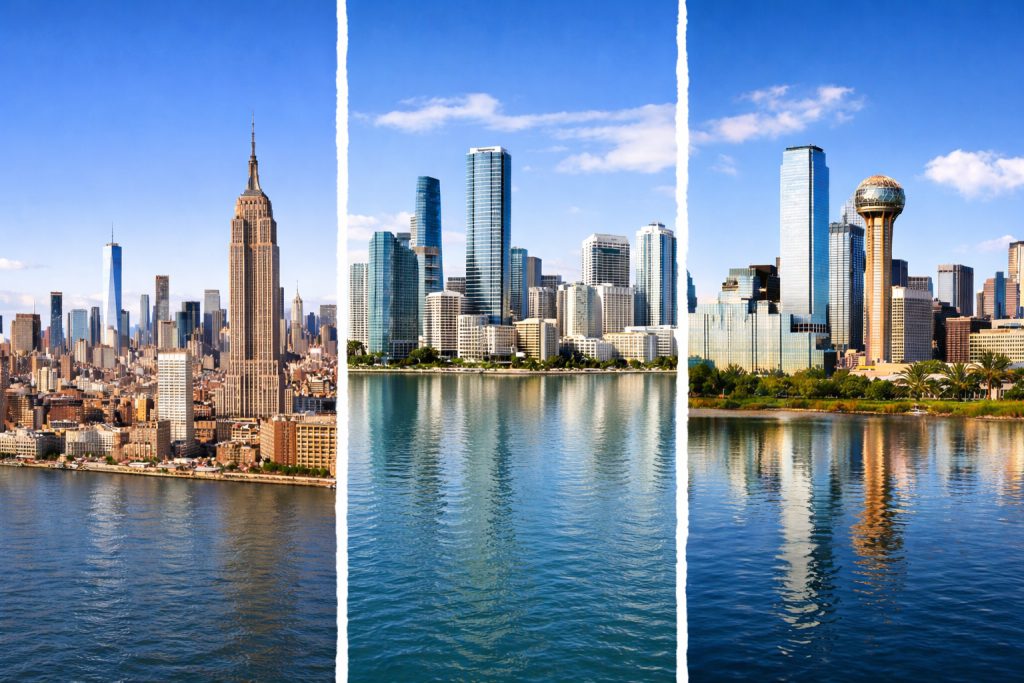
New York City, Miami, and Dallas skylines highlight how affordability is influencing where people choose to live