
🏙️🔑 Manhattan rental listings plunged 39% in a year. The bigger question is whether those apartments actually disappeared or simply became harder for renters to find.
The Manhattan rental market reached another extraordinary milestone in July 2026, with the median rent on newly signed leases climbing to a record $5,000, up 6.4% from a year earlier. Yet the price may not be the most revealing number because publicly advertised rental listings simultaneously plunged more than 39% year over year, one of the steepest declines in roughly a decade.
Brooklyn is experiencing its own squeeze, with its median reaching a record $4,500 as inventory fell 27% from last July. In Manhattan, nearly 19% fewer leases were signed despite record prices, creating an unusual combination of rising costs, declining transactions and dramatically fewer publicly visible choices.
For New Yorkers who have grown accustomed to hearing about another rental record, the more important question may now be what is happening to supply. Did thousands of apartments actually disappear from the Manhattan rental market, or are more available homes simply disappearing from public view?
🔎 IN THIS ARTICLE
- Why is the Manhattan rental market so tight?
- Mamdani promised a more affordable New York. Where are we now?
- Are apartments disappearing or moving out of public view?
- What are REBNY Participant Only listings?
- How does the FARE Act fit into the rental market?
- What does the new Compass antitrust lawsuit allege?
- What does all of this mean for Manhattan renters?
Record Manhattan Rents Are Only Part of the Story
The contrast with much of the country is striking. Nationwide shelter costs increased 3.2% from a year earlier, according to the U.S. Bureau of Labor Statistics, roughly half Manhattan’s 6.4% increase. Zumper reported that the national median rent for a one bedroom was essentially flat in July, and prices have declined in several major cities.
Separate July data from Corcoran put Manhattan’s average rent at $6,655, up 10% annually. Studios averaged $4,088, one bedrooms $5,486 and two bedrooms $8,054, with all three categories reaching record highs.
The difference between average and median rent is worth understanding because extremely expensive apartments can pull the average higher. The median represents the midpoint of the leases measured and can provide a better indication of what a typical renter encounters. Although the two measurements tell us different things, both point toward an increasingly expensive Manhattan rental market.
What makes the latest numbers particularly revealing is the decline in transactions. If rapidly increasing demand were the entire explanation, we might expect more leases to be signed. Instead, leasing activity fell nearly 19% as publicly advertised choices contracted dramatically, suggesting scarcity is playing an important role.
Why Is the Manhattan Rental Market So Tight?
New York’s longstanding housing shortage remains one of the most important forces behind today’s rental conditions. The city’s most recent official Housing and Vacancy Survey found a net rental vacancy rate of just 1.41%, with only about 33,000 units available for rent out of approximately 2.36 million occupied and available rental homes surveyed. It was one of the lowest vacancy rates recorded since the survey began in 1965.
The shortage was even more severe at lower price points. When relatively few apartments are available, renters compete for what remains, property owners have greater pricing power and desirable homes can attract multiple applicants quickly. The extraordinarily low vacancy rate therefore provides essential context for understanding why the Manhattan rental market has remained so expensive.
Higher mortgage rates may be adding another layer of competition because potential purchasers who might ordinarily leave the rental pool can remain tenants longer when financing a home becomes more expensive. Summer traditionally brings additional pressure as leases turn over and many New Yorkers plan moves before fall.
Taken together, limited supply, low vacancy, financing conditions and seasonal competition create an unusually tight housing environment. Those forces, however, do not fully explain why publicly advertised Manhattan inventory could fall more than 39% in a single year.
Mamdani Promised a More Affordable New York. Where Are We Now?
Housing affordability was central to Zohran Mamdani’s campaign for mayor, and it has remained a defining issue since he took office in January 2026. His administration’s Block by Block housing plan calls for building 200,000 new affordable homes and preserving another 200,000 over the next decade, supported by a proposed $22 billion capital investment over five years.
The administration has acknowledged that New York cannot become more affordable without substantially increasing housing production. That recognition is important because the current Manhattan rental market illustrates the scale of the challenge. Median rent has reached $5,000, publicly advertised listings have fallen more than 39% and the city’s vacancy rate remains exceptionally low.
Those figures should not be interpreted as evidence that the Mamdani administration caused today’s conditions. New York’s housing shortage developed over decades, and an administration that has been in office for less than a year cannot build hundreds of thousands of homes overnight. Housing construction, zoning changes, financing and development all require time.
The current numbers do, however, establish a useful benchmark for measuring whether the city’s affordability agenda ultimately produces results. The challenge is not simply limiting certain housing costs. New York also needs enough homes to give people more choices and relieve pressure on prices.
That makes the question of affordability especially important going forward. If rents continue climbing and available choices remain scarce, New Yorkers will eventually judge housing policies not only by what they promise, but by whether finding and paying for a home becomes easier.
Are Manhattan Apartments Disappearing or Moving Out of Public View?
Part of the 39% decline may have less to do with apartments physically disappearing and more to do with where they are being marketed. Appraiser Jonathan Miller told Bloomberg that a growing share of rental inventory is “going private,” with landlords and brokers keeping some properties away from widely used consumer portals such as StreetEasy and RentHop.
That creates an important difference between available inventory and publicly visible inventory because an apartment can still be offered for rent, actively marketed through real estate professionals and ultimately leased without ever appearing in the search results a consumer sees on a major public website.
🕵🏾♂️ Finding the right apartment may increasingly depend on knowing where else to look, with renters relying exclusively on public portals potentially missing a significant share of what is actually available. For consumers accustomed to opening an app, selecting a neighborhood and price range and assuming the results provide a reasonably complete picture, that represents a significant change in how the Manhattan rental market functions.
What Are REBNY Participant Only Listings?
Understanding the debate requires some background on how New York City’s brokerage community shares properties. The Real Estate Board of New York operates the Residential Listing Service, or RLS, which allows participating brokerage firms and real estate professionals to share exclusive residential listings with one another.
REBNY introduced its Participant Only option in 2024, before the FARE Act. The organization said similar options were already available through listing services elsewhere in the country and RLS participants were interested in bringing the practice to New York City. The designation allows an owner to keep a property off public websites and social media while still making it available for co-brokerage among authorized real estate professionals through the RLS.
Participant Only listings cannot be publicly disseminated or included in mass marketing. REBNY permits one-to-one personalized communication about them, which means an apartment can be actively available and represented by a broker even though someone searching StreetEasy or another major consumer website does not see it.
🔒 As more properties move into private networks or through other restricted marketing channels, consumers have less information when deciding where to live and what they should pay. The implications extend to price transparency because comparing similar apartments is one of the primary ways renters determine whether an asking price appears reasonable.
A renter who sees only a portion of the available supply may believe there are fewer alternatives than actually exist, making visibility increasingly relevant to understanding the Manhattan rental market.
How Does the FARE Act Fit Into the Manhattan Rental Market?
New York City’s Fairness in Apartment Rental Expenses Act, better known as the FARE Act, took effect in June 2025 and changed a longstanding feature of the city’s rental brokerage business.
When a landlord hires a broker to market an apartment, the landlord is now responsible for that broker’s fee rather than requiring the incoming tenant to pay it. Renters remain free to hire their own real estate professional and compensate that person directly.
The legislation was sponsored by New York City Council Member Chi Ossé and was designed to reduce the substantial upfront costs renters often faced when they were required to pay a commission to a broker representing the property owner rather than themselves.
What happened afterward has become part of a larger debate over rents, marketing and publicly visible supply.
StreetEasy supported the FARE Act and has argued that New York’s longstanding housing shortage remains the much larger force behind increasing rents. Real estate industry representatives have raised different concerns, including whether shifting brokerage costs to owners has changed how some landlords price and market their apartments.
REBNY also adjusted its RLS procedures following implementation of the FARE Act. Beginning in August 2025, rental listings designated Participant Only could no longer appear on public websites.
📊 With an extremely low vacancy rate, seasonal competition, elevated mortgage rates and changing marketing practices all influencing rental conditions, the FARE Act is better viewed as one possible contributor to changes in visible supply rather than an explanation for the entire 39% decline. Establishing cause requires separating those forces rather than assigning every change in inventory or price to one policy.
There is also an irony worth considering from the perspective of renters and real estate professionals. If more rental inventory moves away from public portals, working with a tenant’s agent could become more valuable once again because that professional may know about apartments a renter would not easily discover through an online search alone.
If the goal of the FARE Act was to make apartment hunting less costly and more accessible, the movement of inventory away from public view raises a fair question about whether the evolving system has actually made the search easier for consumers or simply changed where they need to look.
Luxury Manhattan Rentals Face an Even Greater Squeeze
The pressure becomes particularly dramatic in the luxury segment, where the median rent among Manhattan’s top 10% of rentals surged 31% annually to $13,750 in July. Publicly advertised luxury inventory was approximately half what it had been a year earlier, representing an even steeper contraction than the overall market.
Bloomberg reports that some upscale rental buildings on the Upper West Side and in the West Village have advertised available apartments through signs outside their entrances rather than placing them on major online portals. In an era when consumers have become accustomed to conducting nearly every stage of a housing search online, finding the right apartment may increasingly depend not only on budget and timing but also on knowing where else to look.
⚖️ Uncertainty surrounding New York City’s pied à terre tax may also be putting additional pressure on the high end rental market. Some prospective purchasers of expensive second homes are reportedly choosing to rent as they wait for greater clarity surrounding the surcharge, potentially leaving would be purchasers competing with traditional renters for an already limited supply of luxury apartments.
Bidding Wars Show What Manhattan Renters Are Facing
The consequences of a tight Manhattan rental market are increasingly visible to apartment hunters, with more than one in four Manhattan rentals leased following a bidding war, according to the Miller Samuel data cited by Bloomberg.
One renter profiled by Bloomberg began searching in May, contacted more than 100 listings and toured approximately 20 apartments. At one Chelsea showing, more than 30 prospective tenants competed for a $2,500 basement studio. She eventually secured a $2,000 rent stabilized studio on the Upper East Side after weeks of monitoring new opportunities and remaining prepared to act quickly.
🏃🏾♂️ Her experience illustrates how affordability and availability can become two different problems because a renter may know exactly what they can afford and still struggle to find enough choices within that budget. When desirable properties attract numerous applicants shortly after becoming available, preparation, timing and access to information become increasingly important.
A New Compass Antitrust Lawsuit Puts Private Listings Under Scrutiny
The debate over private inventory took another turn on August 19, 2026, when two Manhattan renters filed a proposed federal class action antitrust lawsuit against Compass in the U.S. District Court for the Southern District of New York.
The plaintiffs allege that Compass’ growing share of the New York City rental business and its strategy of keeping some listings off public websites have contributed to higher rents, fewer choices and reduced access to available inventory. The complaint points specifically to properties being removed from StreetEasy and distributed through REBNY’s RLS using the Participant Only designation.
Recent reporting on the lawsuit also cites Marketproof data shared by Jonathan Miller indicating that 93% of Participant Only Manhattan listings belonged to Compass or its Anywhere affiliated brands and 78% had previously been publicly available. The same analysis found that Participant Only listings subsequently returned to the public market were repriced an average of 6.4% below their private asking prices. Those figures add another dimension to the debate, although the publication reporting them noted that it had not independently reviewed Marketproof’s findings.
The lawsuit also alleges that Compass has acquired an unusually large share of the New York City brokerage business following its acquisition of Anywhere and its affiliated brands. The plaintiffs are attempting to connect that market position, private listing practices and rising rents under federal and state antitrust law.
These claims are allegations, not findings, and establishing that a particular brokerage strategy caused higher rental prices would require separating that alleged effect from New York’s severe housing shortage, seasonal competition, financing conditions and other forces affecting the Manhattan rental market. Compass declined to comment in reporting about the lawsuit.
🔍 The case nevertheless raises a question that extends beyond any one brokerage or website because if a significant share of available apartments moves out of public view, renters may have greater difficulty comparing their choices and determining what a property is actually worth.
Public Listings Do More Than Help Renters Find Apartments
Online housing platforms have transformed how New Yorkers understand real estate by allowing renters to compare neighborhoods, apartment sizes, amenities and prices. Property owners study competing listings before determining what to charge, and real estate professionals examine available inventory to advise clients about current conditions.
When fewer properties appear publicly, everyone may be working with a less complete picture. That does not mean private listings are inherently problematic because owners can have legitimate reasons for preferring limited exposure, and REBNY’s Participant Only designation reflects an owner’s decision regarding how a property is marketed.
The larger issue is what happens when private inventory becomes a more significant part of the Manhattan rental market. A marketplace in which consumers can easily compare most available properties functions differently from one where a substantial share of choices requires access through other channels.
What About NYC Apartments Sitting Vacant?
There is another supply question that should not be confused with private listings because some apartments may be available but not publicly advertised, whereas others may be vacant and not being offered for rent at all.
Debate continues over how many vacant apartments owners have chosen not to return to the rental market, particularly rent regulated units requiring substantial renovations. Critics of New York’s 2019 rent laws argue that restrictions affecting the economics of regulated apartments have made renovating and re renting some units financially unattractive, whereas tenant advocates and other supporters of the legislation dispute claims about the number of apartments being deliberately kept vacant and the degree to which the law is responsible.
It is therefore important to recognize that not every vacant apartment is unavailable for the same reason. Understanding why those units remain off the market and what would actually return them to active rental use is more useful than treating every vacant property as part of a single category.
That information becomes particularly important when discussing solutions because addressing New York’s housing shortage requires understanding which apartments are unavailable, why they are unavailable and what changes could realistically make them accessible to renters again.
What Does This Mean for the Manhattan Rental Market?
The Manhattan rental market is being shaped by several forces rather than one simple explanation. New York has a longstanding housing shortage, vacancy remains exceptionally low, higher mortgage rates can keep prospective purchasers renting, summer brings seasonal competition and some available apartments are being marketed outside the public portals consumers routinely search.
The FARE Act has changed the economics of rental brokerage, raising questions about how owners and agents respond to those costs and how properties are marketed. At the luxury level, uncertainty surrounding the pied à terre tax may be adding another source of rental demand, and the newly filed Compass lawsuit has brought additional scrutiny to the relationship between private listings, consumer access and competition.
Mayor Mamdani’s affordability agenda adds another important piece to the discussion because his administration is proposing a substantial increase in affordable housing production and preservation. Those efforts will take years to evaluate, but today’s record rents, limited vacancy and shrinking public inventory establish the conditions against which their success will eventually be measured.
Because these forces overlap, isolating exactly how much each contributes to rising rents is difficult. The 39% decline in publicly advertised Manhattan listings nevertheless deserves attention because understanding today’s rental conditions requires looking not only at how much housing exists, but also at how much of it consumers can readily find.
The Bigger Question Facing Manhattan Renters
🏘️ New York’s housing shortage did not appear overnight and will not be solved by one policy, brokerage practice, mayoral administration or technology platform. Building more housing remains essential, but so does understanding how much existing inventory is available, where it is being marketed and whether consumers have enough information to make informed decisions.
The Manhattan rental market is confronting an unusual combination of record prices, dramatically fewer publicly advertised listings and declining leasing activity, suggesting that scarcity and visibility are becoming increasingly intertwined.
👀 For people trying to rent in Manhattan, affordability is no longer the only hurdle because finding enough choices to make an informed decision is becoming part of the challenge. If more rental properties continue disappearing from public view, the question may not simply be how high Manhattan rents can climb, but how much of the Manhattan rental market New Yorkers can actually see.
Thinking About Renting, Buying, Selling or Investing in Manhattan?
New York City’s housing landscape continues to evolve, and understanding what is happening beyond the public listing portals can be increasingly important for renters, buyers, property owners and investors. If you are considering renting, buying, selling or investing in Manhattan, feel free to reach out. I am happy to discuss current market conditions, available inventory, pricing and how these changes may affect your real estate strategy.
For individualized legal or tax advice concerning the FARE Act, rent regulation, antitrust law or New York City’s pied à terre tax, consult a qualified attorney or tax professional.
Frequently Asked Questions About the Manhattan Rental Market
What is the median rent in Manhattan in 2026?
The median rent on new Manhattan leases reached a record $5,000 in July 2026, according to Miller Samuel and The Real Deal data cited by Bloomberg. That represented an increase of 6.4% from a year earlier.
Why did Manhattan rental listings fall 39%?
There is no single established explanation for the decline. New York’s housing shortage, seasonal competition and changes in how apartments are marketed are among the factors being discussed. Some properties may remain available even though they no longer appear on major consumer portals.
What is a REBNY Participant Only listing?
Participant Only is a marketing designation within REBNY’s Residential Listing Service. An owner can elect to have a property shared among authorized RLS participants without allowing it to be publicly distributed through consumer websites or social media.
Did the FARE Act cause Manhattan rents to rise?
Available evidence does not support attributing Manhattan’s rent increases to the FARE Act alone. New York’s housing shortage, exceptionally low vacancy rate, seasonal demand, financing conditions and changes in marketing practices are all affecting the market. The effect of the FARE Act on rents and publicly visible inventory remains debated.
Can a renter still hire a real estate agent under the FARE Act?
Yes. The FARE Act does not prevent renters from choosing their own agent and paying that professional’s fee. When a landlord hires a broker to represent the landlord, however, the landlord cannot require the incoming tenant to pay that broker’s fee.
Why would a Manhattan rental not appear on StreetEasy?
There can be several reasons. An owner may choose a marketing strategy that does not include public distribution, including REBNY’s Participant Only designation. A property may also be marketed through other channels or may not currently be offered for rent.
What is Mayor Mamdani proposing to address NYC housing affordability?
Mayor Mamdani’s Block by Block plan calls for building 200,000 new affordable homes and preserving another 200,000 over the next decade, supported by a proposed $22 billion capital investment over five years. Because the plan is long term, it is too early to judge its effect on current Manhattan rents.
What is the Compass rental lawsuit about?
Two Manhattan renters filed a proposed federal class action antitrust lawsuit in August 2026 alleging that Compass’ market position and private listing strategy restricted access to rental inventory and contributed to higher prices. Those claims remain allegations and have not been established by a court.
📚 SOURCES AND FURTHER READING
- Manhattan rents, shrinking inventory and luxury rental market
Bloomberg, Manhattan Rents Hit $5,000 Record While Listings All But Vanish, Paulina Cachero, August 13, 2026. This is the primary reporting behind the $5,000 median rent, 39% decline in Manhattan listings, nearly 19% decline in leasing activity, Brooklyn figures, luxury rental data and discussion of private inventory. - Manhattan rental listings just plunged 39% in a year. So where did all the apartments go?
- New York City Housing and Vacancy Survey NYC Department of Housing Preservation and Development. 2023 Housing and Vacancy Survey Selected Initial Findings. The city’s official housing survey reports a 1.41% rental vacancy rate and only 33,210 available rental units out of approximately 2.36 million occupied and available rental homes surveyed.
- The FARE Act and NYC broker fees New York City Council. The FARE Act. Official information from Council Member Chi Ossé’s office explaining the Fairness in Apartment Rental Expenses Act, its June 11, 2025 effective date and how the law changed responsibility for broker fees. It also confirms that renters may still independently hire their own broker.
- REBNY Participant Only listings Real Estate Board of New York. RLS Syndication Options. REBNY’s explanation of Participant Only listings, including how owners can elect to share a property among authorized RLS participants without allowing it to be publicly disseminated.
- REBNY rental listing visibility following the FARE Act Real Estate Board of New York. Rental Internet Display Setting Update. REBNY’s guidance explaining changes to rental internet display settings following implementation of the FARE Act and confirming that Participant Only rental listings cannot appear on public websites.
- Compass antitrust lawsuit and private listings Real Estate News. NYC Renters Sue Compass Over Alleged Monopoly, Inflated Rents. Coverage of the proposed federal class action filed by two Manhattan renters challenging Compass’ market position and private listing strategy. The allegations have not been established by a court.
- Mamdani Block by Block housing plan
- StreetEasy’s one year FARE Act analysis
- Why You Need A Real Estate Agent In New York City (2026 Guide)
📞 THINKING ABOUT BUYING, SELLING OR RENTING IN NEW YORK CITY?
Record Manhattan rents, limited publicly advertised inventory, private listings and changes in how rental apartments are marketed are reshaping the choices available to New Yorkers. Understanding what is happening beyond the major public portals may be increasingly important when navigating today’s market.
If you are considering buying, selling or renting a home in New York City, feel free to reach out 📩. I am happy to discuss current market conditions, pricing, available inventory and how changes in housing supply may affect your real estate strategy.
For individualized legal or tax advice concerning the FARE Act, rent regulation, broker fees, antitrust matters or New York City’s pied à terre tax , consult a qualified attorney or tax professional.
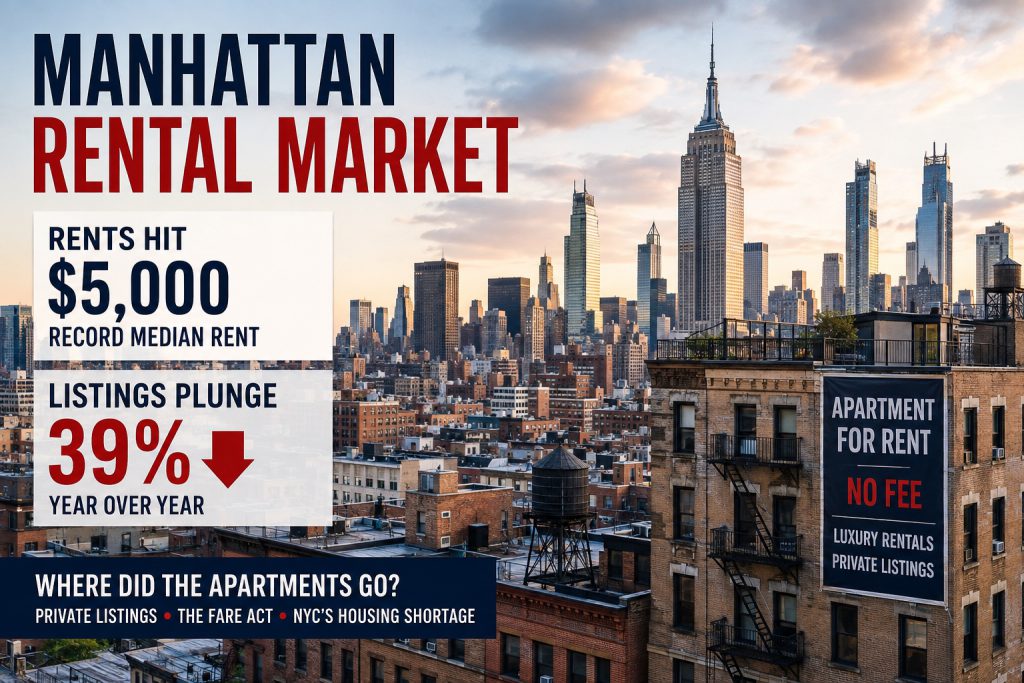
Manhattan’s median rent reached a record $5,000 in July 2026 as publicly advertised rental listings plunged more than 39% year over year.

Brian Phillips | The Mobile Broker | New York City Real Estate Advisor and Housing Market Commentator